
Solar Roof Integration in Richmond, VA
Solar-ready commercial roofing in Richmond, VA. We handle PV racking penetrations, membrane compatibility, ballast weight, perimeter uplift, and the warranty handoff between roofer and solar installer.
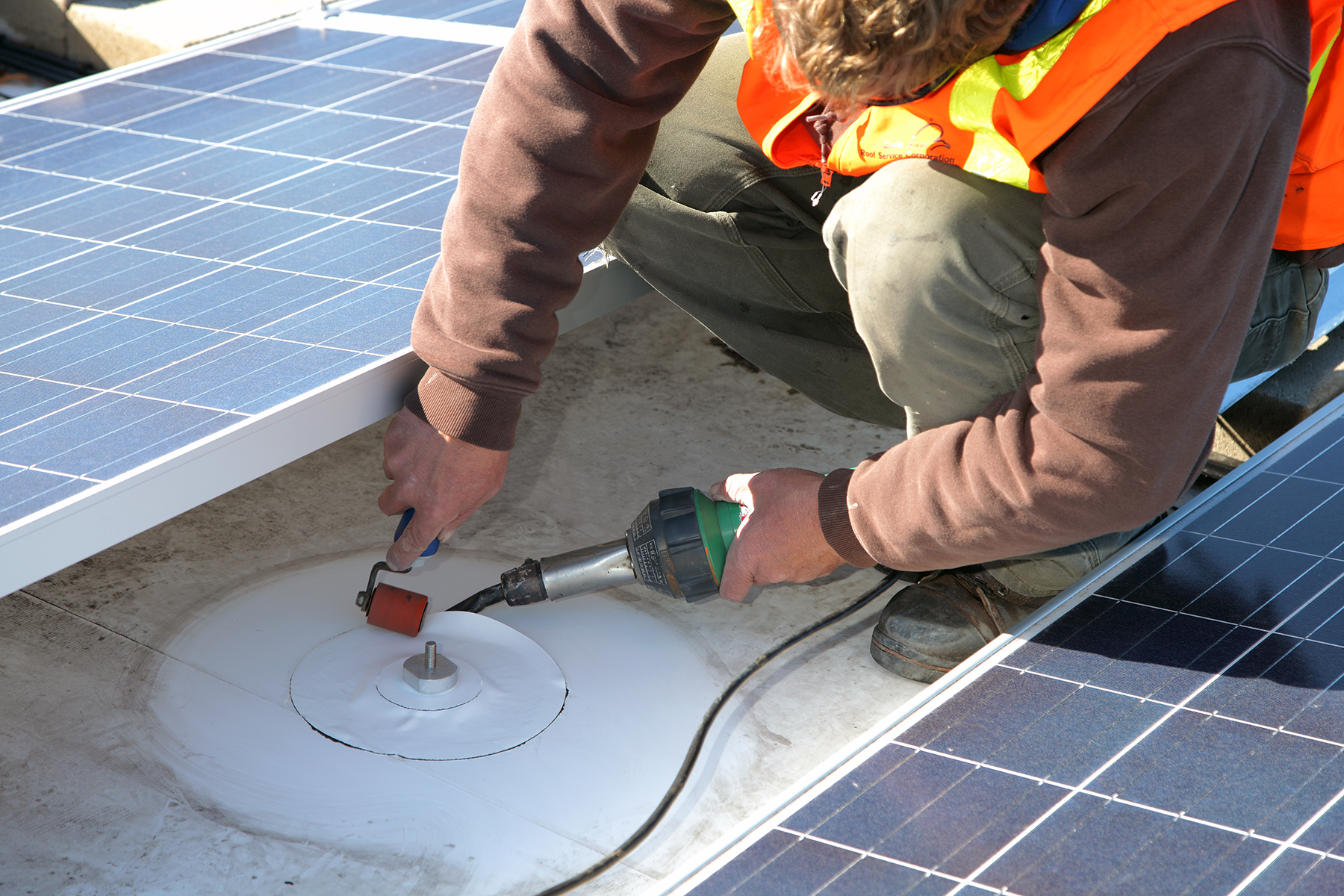
The economics of rooftop solar only work if the roof beneath the array lives at least as long as the panels bolted to it, and on most of the commercial buildings we look at across Richmond, that is exactly the assumption nobody checks. A property owner gets a production estimate from a solar developer, signs it, and discovers two years later that the membrane the array sits on was already near the end of its life. We get involved before that happens, because a solar project is a roofing project wearing a different hat, and the roof has to be the first thing on the table, not the last.
The roof decides the timeline, not the panels
Our first move on any solar-readiness review is to core the existing membrane and put an honest number on how many years it has left. That single figure governs everything downstream. A photovoltaic system carries a service life measured in decades, and mounting one on a roof with a fraction of that left commits the owner to a detach-and-reset cycle when the roof finally has to come off. Pulling an array, racking it on the ground, re-roofing underneath, and resetting the whole system is one of the most expensive things that can happen to a commercial roof, and it is entirely avoidable with one core sample and an honest conversation up front.
When the membrane is near end of life, the right answer is almost always to re-roof first and pair the two scopes so the building gets disrupted once instead of twice. That is rarely the news an owner wants when a glossy solar proposal is already in hand, but combining the re-roof with the install lets us specify a membrane built to host an array rather than working around whatever happens to be up there. It is the cheaper path measured across the life of the building, even when it looks like the more expensive one on day one.
Where racking meets membrane, two trades share one watertight surface
Every standoff, every racking foot, and every conduit run that touches the roof is a place water can get in and a place two contractors can point fingers at each other. The solar installer owns the electrical production. We own keeping the building dry. When a leak shows up near a panel eighteen months later, that split is where projects go sideways unless the responsibilities are drawn cleanly before anyone goes up.
On attachment-based systems, we flash every penetration ourselves, to the membrane manufacturer's published detail, so the roof warranty survives. We do not let a racking crew set its own feet and seal them with a bead of caulk. On low-slope roofs, ballasted racking is frequently the smarter choice because it holds the array down with weighted trays and never punctures the field of the membrane at all. Which approach fits a given building depends on the deck, the slope, and the wind exposure, not on whatever the installer happens to stock.
Weight and uplift are structural problems with one right answer each
Ballast trades the leak risk for dead load, and dead load has its own ceiling. A lot of the older masonry and steel-deck buildings in Scott's Addition, Manchester, and along the Boulevard were never designed to carry extra pounds per square foot of concrete pavers. We verify the proposed array-plus-ballast weight against the building's actual structural capacity before anyone commits to that layout, and where the structure cannot take it, we move to an attached or hybrid system instead.
Uplift is the same question from the other direction. A solar array behaves like a sail. Wind moving across a low-slope roof generates lift on the modules and concentrates suction at the corners and along the perimeter, which is precisely where the edge metal and the array's anchorage are already working hardest. The racking has to be engineered to the local design wind speed, and those perimeter zones routinely need a tighter attachment pattern or more ballast than the open field of the roof. This never shows up on a calm day. It shows up when the next strong storm line rolls through Central Virginia and an under-anchored array lifts and peels the membrane edge along with it.
Why so much of Richmond's roof stock gets the solar pitch
Solar developers chase open square footage, and Richmond has it. The big-box distribution roofs along the Interstate 95 and Interstate 295 corridors, the flex and warehouse buildings clustered near the Richmond Marine Terminal and the Deepwater Terminal industrial area, and the large flat retail roofs out by Short Pump and along West Broad all present the same profile: wide, low-slope membranes with little obstruction and a clear southern exposure. That is what makes them attractive, and it is also why so many of these solar conversations land on roofs that are nowhere near ready to host a thirty-year asset. The square footage that draws the developer is the same square footage that has been baking through Richmond summers for fifteen years.
Coordinating two warranties so one does not void the other
The membrane manufacturers that owners want a long-term warranty from will allow rooftop solar, but strictly on their terms. That means approved attachment details, approved walk pads and protection mats under and around the array, and a pre-installation review by the manufacturer's field representative. Skip that review and you can void the very warranty the solar project was supposed to sit beneath.
We run that coordination so it does not slip through the cracks. We bring the manufacturer's representative in before installation, document the approved details, set the sequence so the membrane is down and inspected before any racking is staged, and make sure conduit penetrations are flashed by us rather than by the electrician pulling wire. The result is a clean handoff: the array is registered with the solar provider, the roof is registered with the membrane manufacturer, and the paperwork shows plainly who answers for what.
What we deliver
- A cored, documented assessment of the existing membrane with a remaining-service-life estimate, so the decision to re-roof first is made on evidence.
- A penetration and flashing plan coordinated with your solar developer, with us owning every detail that touches the waterproofing.
- Structural confirmation of array and ballast weight, plus engineered uplift resistance with tighter perimeter anchorage where the wind zone calls for it.
- Manufacturer warranty review and a documented installation sequence so both the roof and the array warranties stay valid.
We do not sell solar, and that is on purpose. It means the only thing we have riding on your project is the roof under the panels, so our advice on timing and details is not bent by a module quota. If you are weighing a rooftop array on a Richmond commercial building, call 804-689-3469 or email estimates@commercialroofingrichmond.com and we will tell you straight whether your roof is ready to carry it.
Common Questions
Should we re-roof before installing solar?
If the existing membrane has roughly fifteen or more years of documented life left, mounting on it is usually fine. If it has under eight, re-roofing first nearly always saves money, because detaching and resetting an array during a future tear-off costs far more than coordinating both scopes at once. We core the roof and hand you the service-life number so the call is grounded in fact.
Do solar panels require holes in the roof?
Not always. Ballasted racking holds the array with weighted trays and avoids penetrating the field of a low-slope membrane. Attachment-based systems do penetrate, and we flash each foot to the manufacturer's detail. Which approach we recommend depends on the slope, the structure's load capacity, and the wind exposure on that specific building.
Will adding solar void the roof warranty?
Only if the work is done outside the manufacturer's rules. Most major membrane manufacturers permit rooftop solar with approved attachment details, protection mats, and a pre-install field review. We arrange that review and document the approved details so the warranty stays in force.
Who is responsible if a leak shows up around a panel?
That is exactly what we settle in advance. Because we own and flash every penetration that touches the membrane, the waterproofing responsibility stays with us instead of getting lost in a dispute with the solar installer. The two-warranty handoff is documented so the line never blurs.
Talk to a Richmond commercial roofer
Tell us about the building and the issue. We will set up a roof walk and get you a clear, documented scope.